
Introduction
We’ve all been there—it’s 11:00 PM, and you’ve just spent the last four hours staring at a screen. Maybe you were working through a complex project, or perhaps you were enjoying a deep dive into the latest trivia on PlayAIQuiz.com. Suddenly, you realize your eyes feel like they’re full of sand, your vision is slightly blurry, and a dull headache is starting to form right behind your temples. You reach for your phone to look up a “Vision Health Score,” hoping to find out if this is just a long day or something more serious.
In our hyper-connected world, eye health has moved from a “once-a-year checkup” concern to a daily necessity. We are constantly battling digital strain, yet many of us don’t actually have a plan for long-term vision care. For the dedicated quiz attempter, these health assessments are more than just a distraction; they are a vital reality check. They force us to pause and ask: “Am I actually looking after the only pair of eyes I’ll ever have?”
Whether you are browsing the Health & Deficiency section to see if your diet supports your sight, or checking in on how screen fatigue affects your Mental Health & Psychology, understanding the mechanics of ocular stress is key. This guide is built for those who love to learn through testing and want to turn their results into a clearer way of seeing the world.
The Quiz-Taker’s Perspective: Why We Audit Our Eyes
People who enjoy online quizzes are usually looking for a “why.” We don’t just want to know our eyes hurt; we want to understand the habits that led us here. This analytical mindset is a huge advantage when it comes to maintaining your well-being.
Moving From Guesswork to Metrics
In general, we are terrible at judging our own screen time. We think we’ve been “working for an hour,” but our devices tell a different story. Taking a quiz provides an objective mirror. It asks about your blink rate, your monitor distance, and your lighting—details you likely ignore while you’re focused on a task. It turns vague discomfort into actionable data.
The Psychology of Self-Correction
There is a specific satisfaction in identifying a problem you can actually fix. For many quiz attempters, seeing a low score for “Screen Hygiene” is the exact nudge they need to finally move their desk closer to a window or buy a pair of blue-light glasses. It’s about the shift from being a passive victim of fatigue to an active manager of your own vision care.
Common Mistakes When Assessing Vision Health
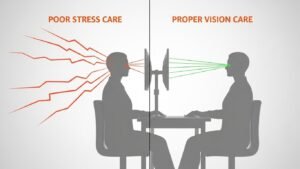
Based on common experience, we often misinterpret what our eyes are trying to tell us. Accuracy in any self-assessment requires looking past the obvious.
Assuming “Perfect Vision” Means Healthy Eyes
A common mistake many people notice is the belief that because they don’t need glasses, their eye health is perfect. You can have 20/20 vision and still suffer from severe digital strain. Chronic dryness, redness, and “computer vision syndrome” have nothing to do with your prescription and everything to do with how you use your eyes.
Overlooking the “Secondary” Symptoms
When taking a quiz, many people only look for “blurry sight.” However, digital strain often shows up as neck pain, light sensitivity, or even a sudden drop in concentration. In the world of Lifestyle & Finance, your ability to focus is your greatest asset. If you’re ignoring the headaches because “my eyes feel okay,” you’re missing the bigger picture of how your ocular health impacts your entire day.
Benefits of Quizzes for Long-Term Learning and Awareness
Think of an online assessment as a “micro-seminar.” Every question is designed to teach you a standard of care you might not have known existed.
Learning the “20-20-20” Rule
Before taking a check-in, many people have never heard of the 20-20-20 rule (every 20 minutes, look at something 20 feet away for 20 seconds). Quizzes introduce these simple, evidence-based habits in a way that sticks. It’s a low-pressure environment to learn about things like “contrast sensitivity” or “flicker rate.”
Identifying Nutritional Gaps
A thorough assessment might ask about your intake of leafy greens or Omega-3s. This links your kitchen habits directly to your vision care. You begin to see that what you eat for lunch has a direct impact on how tired your eyes feel by 5:00 PM. This holistic view is what makes quiz-based learning so effective for the modern user.
How Assessments Improve Knowledge and Confidence

Every time you finish a health check-in on PlayAIQuiz.com, you aren’t just getting a score—you’re getting a vocabulary.
-
Better Conversations with Pros: When you finally go for your eye exam, you can say, “I’ve noticed I have trouble with contrast after three hours of work,” instead of a vague “my eyes hurt.” This specificity leads to better care.
-
Proactive Protection: Knowledge removes the “fear factor.” When you understand why digital strain happens (the ciliary muscle in your eye getting locked in a near-focus position), you stop worrying that you’re going blind and start focusing on exercises to relax that muscle.
-
Documenting the Journey: Many people find it helpful to keep a wellness log. If you’re serious about your habits, using a resource like Ainotes.pk to organize your quiz results and track which ergonomic changes actually reduced your headaches is a fantastic way to see long-term progress.
Strategy Guide: Habits vs. Better Vision Approaches
To help you get the most out of your next eye health assessment, let’s look at the “Quick Fixes” people try versus the strategies that actually work.
| Common Mistake | Potential Impact on Eyes | The “Pro” Vision Care Approach |
| Increasing screen brightness to see better | Causes glare and severe eye fatigue | Match screen brightness to room light levels |
| Rubbing eyes when they feel dry | Risk of corneal scratches and infection | Use preservative-free artificial tears |
| Working in a dark room with a bright screen | Creates harsh contrast; causes strain | Use soft, indirect ambient lighting |
| Leaning closer to the screen to focus | Ruins posture and increases muscle load | Increase font size and keep screen at arm’s length |
| Powering through the “sandpaper” feeling | Leads to chronic dry eye syndrome | Take an immediate “eye break” and blink more |
The Long-Term Value of Vision Literacy
In general, the way we use our eyes has changed more in the last 20 years than in the previous 2,000. Our biology hasn’t caught up to our technology yet.
Staying Resilient in a Screen-First World
Whether you’re checking your portfolio in Lifestyle & Finance or studying for a certification, you can’t escape the screen. By becoming an expert in your own eye health, you aren’t just avoiding pain; you’re protecting your career and your quality of life. Resilience comes from knowing your limits and having the tools to push them back safely.
Reducing “Focus Burnout”
There is a direct link between eye fatigue and mental exhaustion. When your eyes struggle to focus, your brain has to work twice as hard to process information. By mastering your vision care, you’re actually saving mental energy. You’ll find you can work longer, think clearer, and enjoy your downtime more because you aren’t fighting a headache.
Conclusion: Take the Vision Challenge
Your eyes are the primary way you experience the beauty and complexity of the world. Treating them as an afterthought in our digital age is a risk we simply can’t afford. By leaning into the curiosity that brings you to sites like PlayAIQuiz.com, you’re already ahead of the curve.
Don’t wait for your vision to become blurry to start paying attention. Use the assessments as a guide to build a “Vision First” lifestyle. Dim the lights, move your monitor, remember to blink, and most importantly, keep learning. Every small change is a step toward a brighter, clearer future. Your eyes do so much for you; it’s time to return the favor.
FAQs for Eye Health Quiz Attempters
1. Can an online quiz tell me my exact prescription?
No. An online assessment measures symptoms of digital strain and lifestyle habits. Only a comprehensive exam by an optometrist or ophthalmologist using specialized equipment can determine an accurate prescription for glasses or contacts.
2. Is blue light the only thing causing my eye pain?
In general, no. While blue light is a factor, “computer vision syndrome” is usually a combination of glare, poor contrast, incorrect viewing distances, and—most importantly—a reduced blink rate while looking at screens.
3. Does using “Dark Mode” actually help my eyes?
Many people notice that Dark Mode is easier on the eyes in low-light environments. However, for long-form reading in a bright room, light mode with high contrast (black text on white) is often actually less straining for the brain to process.
4. Why do my eyes feel drier when I’m focused on a quiz?
Research shows that we blink about 66% less often when we are looking at a digital screen. This causes the tear film on your eye to evaporate faster, leading to that “sandpaper” or gritty feeling.
5. How often should I take a vision health check-in?
A monthly “audit” of your workspace and symptoms is a great way to stay on top of your vision care. If you start a new job or increase your screen time, do a check-in immediately to adjust your habits.