Have you ever looked at your phone, saw a friend’s name popping up for a call, and felt a genuine sense of dread? Not because you dislike them—you actually love them—but because the mere thought of speaking out loud feels like trying to run a marathon in sand. This is the classic “social battery” dilemma. For those of us who spend time on PlayAIQuiz.com, this specific feeling often leads us straight to a search for answers. We want to know if these personality traits are permanent or if our emotional health is simply taking a temporary hit.
The surge in popularity of the introvert quiz isn’t just a trend; it’s a sign that people are more eager than ever to understand their internal limits. We are looking for a way to categorize our exhaustion. Is this just who I am, or am I “burnt out”? Distinguishing between a natural inclination toward solitude and a state of being emotionally overextended is crucial. It affects how you manage your Lifestyle & Finance and how you navigate the complexities of Mental Health & Psychology.
The Quiz-Taker Mindset: Searching for Self-Validation
When we click on a personality assessment, we are usually looking for a “permission slip.” We want a score to tell us that it’s okay to stay home on a Friday night or that our need for quiet isn’t a flaw, but a feature.
The Psychology of Labeling
Labels can be incredibly freeing. If a quiz helps you identify as an “introvert,” it provides a framework for your behavior. It moves the narrative from “I’m antisocial” to “I recharge in solitude.” Based on common experience, many people notice that once they have a name for their experience, their self-criticism drops significantly.
Data as a Tool for Growth
For the frequent quiz attempter, every result is a piece of a larger puzzle. You aren’t just taking one test; you’re building a library of self-knowledge. This proactive approach to learning about oneself is the foundation of a healthy ego. It allows you to advocate for your needs in relationships and at work because you finally have the “data” to back up how you feel.
Common Mistakes in Assessing Your Social Battery
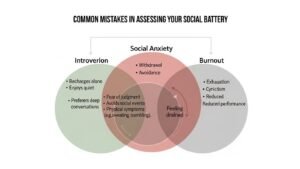
Even with the best intentions, we can sometimes misread our own results. Understanding the nuances of personality is a skill that takes time to develop.
Confusing Introversion with Burnout
One of the most frequent mistakes is assuming that a sudden drop in social energy means you’ve “become” an introvert. Introversion is one of several stable personality traits, whereas emotional exhaustion is a state of being. If you used to love parties and now find them physically painful, you might be dealing with emotional health stressors rather than a shift in your core personality.
Answering Based on “Should” Instead of “Is”
We all have a version of ourselves that we wish we were—the “ideal” self. When taking an introvert quiz, many people answer based on who they want to be. They might mark themselves as more social than they are because they feel guilt about their need for space. This “good student” bias leads to inaccurate results that don’t actually help you manage your energy in the long run.
Benefits of Quizzes for Learning and Awareness
While they aren’t clinical diagnoses, educational quizzes offer a unique form of “micro-learning” that is hard to get from textbooks.
Gamified Self-Reflection
Traditional self-help can feel like a chore. Quizzes turn the mirror toward the user in a way that feels engaging and low-pressure. By answering questions about your Health & Deficiency or your social habits, you are forced to pause and actually think about your recent choices.
Breaking Down Complex Concepts
Most people don’t have time to read academic papers on social psychology. A well-crafted assessment breaks down these high-level theories into relatable scenarios. It translates “circadian rhythm” or “extroversion-introversion spectrum” into “How do you feel at a 3:00 PM meeting?” This accessibility is what makes quiz-based learning so effective for the general public.
How Assessments Improve Confidence and Knowledge

There is a specific kind of “aha!” moment that happens when a result screen perfectly describes a feeling you couldn’t put into words.
-
Reducing Isolation: Seeing that thousands of others have taken the same test and received the same result makes you feel less like an outlier.
-
Providing a Vocabulary: Learning terms like “social hangover” or “overstimulation” gives you the words to explain your needs to extroverted friends or family.
-
Encouraging Healthy Boundaries: When you understand your battery levels, you stop apologizing for leaving the party early. You realize it’s a biological necessity, not a personal failing.
For those who enjoy deep-diving into these topics, keeping a log of your results and what you’ve learned can be incredibly helpful. Using a tool like Ainotes.pk to organize your personal development notes ensures that your “aha!” moments aren’t forgotten the next day.
Comparing Mental States: Introversion vs. Exhaustion
To help you distinguish between your core nature and your current stress levels, consider the following comparisons.
| Feature | Introversion (Trait) | Emotional Exhaustion (State) |
| Duration | Consistent throughout life | Appears during high-stress periods |
| Recovery | Solitude feels peaceful and renewing | Solitude feels heavy or “numb” |
| Motivation | Prefer small groups or 1-on-1 | Feel a “dread” toward any interaction |
| Enjoyment | Can enjoy social events in short bursts | Find no joy in previously loved activities |
| Outcome | Recharge leads to creative energy | “Recharge” only leads to more sleepiness |
The Long-Term Value of Quiz-Based Learning
The real magic happens when you stop viewing a quiz as a one-off game and start seeing it as a long-term awareness tool.
Tracking Seasonal Changes
Many people notice that their social battery fluctuates with the seasons or their workload. By revisiting a personality or emotional health check-in every few months, you can spot patterns. Perhaps your “introversion” spikes every December due to holiday stress, or maybe your energy levels are tied to your Health & Deficiency status, like Vitamin D levels in winter.
Building a Stronger Mind-Body Connection
Eventually, you won’t even need the quiz. You’ll begin to recognize the physical sensations of a draining battery—the tight chest, the wandering mind, the irritability. This heightened “interoception” (awareness of your body’s internal state) is the ultimate goal of all mental health screenings.
Embracing Your Results
Whether your results point toward deep-seated personality traits or a temporary need to focus on your emotional health, the goal is the same: radical self-acceptance. In general, the most successful people aren’t the ones with the “most” energy; they are the ones who know exactly how to manage the energy they have.
Don’t be afraid to take that introvert quiz and lean into what it tells you. Use it as a starting point for a better conversation with yourself. Head over to PlayAIQuiz.com to explore more about your psychology and lifestyle. Every click is a step closer to a version of you that feels balanced, understood, and—most importantly—well-rested.
FAQs for Quiz Attempters
1. Can an extrovert become an introvert?
In general, core personality traits are fairly stable throughout adulthood. However, someone can go through a period of “introversion-like” behavior due to high stress, trauma, or major life changes. This is usually emotional exhaustion rather than a change in personality type.
2. Why do I feel guilty for needing alone time?
We live in a culture that often prizes “hustle” and constant connection. This can lead to a “guilt gap” when your body needs to rest. A quiz can help validate that your need for space is a biological requirement, not a character flaw.
3. How accurate is an introvert quiz?
While online assessments aren’t the same as a 4-hour psychological evaluation, they are excellent at identifying general tendencies and sparking self-reflection. They are a “temperature check” for your current mental state.
4. What is the “Social Hangover”?
This is the physical and mental fatigue that hits after an introvert has spent too much time in high-stimulation environments. Symptoms include brain fog, irritability, and a desperate need for silence.
5. Should I share my quiz results with others?
Sharing your results can be a great way to help friends and family understand your boundaries. It moves the conversation from “I don’t want to see you” to “My battery is low, and I need to recharge so I can be present with you later.”