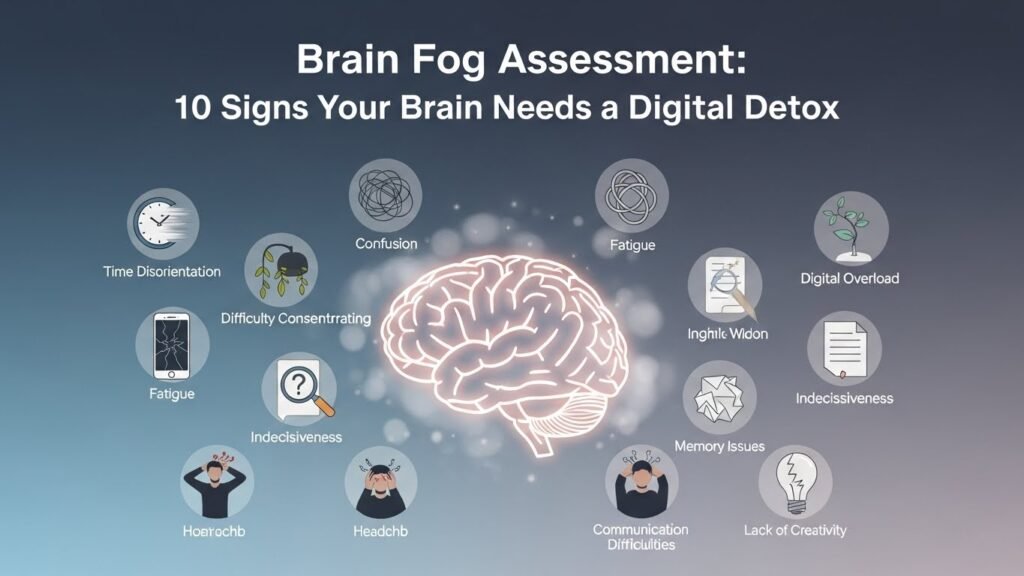
Ever found yourself staring at a computer screen, reading the same sentence four times, and still having no clue what it says? Or maybe you’ve walked into a room only to stand there wondering what on earth you were looking for. If you’re a fan of testing your wits on PlayAIQuiz.com, these moments of “static” in your head can be incredibly frustrating. You want to perform well, you want to be sharp, but the gears just aren’t turning.
This is what many call “the fog.” When we look at cognitive health, we often realize that our brains aren’t broken; they’re just overstimulated. In an age of endless notifications and infinite scrolling, identifying the specific brain fog causes is the first step toward reclaiming your mental clarity.
For those who love a good self-assessment, understanding why your brain feels “laggy” is about more than just a score. It’s about auditing your digital lifestyle to see if your tech is helping you or hindering you. Whether you’re diving into Mental Health & Psychology or checking your stats in Lifestyle & Finance, getting your focus back is the ultimate productivity hack.
The Quiz-Taker’s Mindset: Why We Seek Assessment
People who spend time on quiz platforms are usually high-achievers or lifelong learners. You don’t just want to know that you feel foggy; you want to know why. This analytical mindset is exactly what you need to solve the puzzle of mental fatigue.
Moving Beyond the Surface
A simple “Are you tired?” doesn’t cut it for the curious mind. We look for patterns. Taking a check-in on Health & Deficiency might reveal that your fog isn’t just about sleep, but perhaps about hydration or a lack of specific nutrients. Quizzes serve as a structured way to ask the questions we often forget to ask ourselves in the middle of a busy workday.
The Satisfaction of the “Check-In”
In general, there is a deep psychological relief in seeing your feelings translated into data. When a quiz confirms that your focus is down by 20% compared to last month, it validates your experience. It’s no longer “all in your head”; it’s a measurable state that you can now address with a plan.
Common Mistakes When Evaluating Brain Fog
Based on common experience, we often misdiagnose our own mental sluggishness. We reach for more coffee when we actually need a nap, or we buy a new planner when we actually need to delete an app.
Over-Reliance on Stimulants
Many people notice that when the fog rolls in, their first instinct is caffeine. While a cup of coffee can provide a temporary boost, it often masks the underlying brain fog causes, such as poor cognitive health or digital burnout. This leads to a “crash and burn” cycle that makes the fog even thicker the next day.
Ignoring the “Digital Noise”
We often forget that our brains have a limited bandwidth. Every notification is a “micro-interruption” that drains your mental battery. If you’re taking quizzes to improve your knowledge but doing so while your phone is buzzing every thirty seconds, you aren’t actually learning; you’re just reacting.
How Quizzes Help Build Confidence and Knowledge

One of the biggest benefits of quiz-based learning is that it builds a “mental map” of your own capabilities. It isn’t just about the answers; it’s about the process of reflection.
Reinforcing What You Know
When you successfully navigate a difficult quiz, it provides a hit of dopamine that reinforces your confidence. This is vital for cognitive health. It reminds you that despite the fog, your knowledge base is still there; you just need to clear the path to get to it.
Learning Through Active Participation
Reading a long-form article is passive. Taking a quiz is active. By forcing your brain to retrieve information, you are strengthening the neural pathways associated with that topic. This is why many students find that using resources like Ainotes.pk to organize their quiz findings and study materials is a total game-changer for long-term retention.
Strategies for a Successful Digital Detox
If your assessment shows that you’re struggling with mental clarity, it might be time for a “reset.” You don’t have to move to a cabin in the woods; you just need to set boundaries.
| Habit | Resulting Outcome | Better Approach |
| Checking phone immediately upon waking | Sets a reactive, “foggy” tone for the day | 30 minutes of no-tech time after waking |
| Multitasking with multiple browser tabs | Fragments attention and lowers IQ | Single-tasking with “Focus Mode” enabled |
| Endless scrolling before bed | Disrupts sleep and morning clarity | Reading a physical book or journaling |
| Ignoring “Brain Breaks” | Causes cognitive fatigue and burnout | The 50/10 rule (50 mins work, 10 mins rest) |
| Using tech for every minor task | Weakens natural memory and navigation | Practice “analog” tasks like paper note-taking |
The Long-Term Value of “Mental Audits”
In general, your brain is like a muscle. It needs a balance of intense work and deep rest. Regular check-ins via online assessments help you maintain this balance.
-
Tracking Trends: Taking a monthly quiz allows you to see how lifestyle changes—like a digital detox—are actually impacting your focus.
-
Early Warning Signs: Sometimes, persistent fog is a sign that something else is off in your Health & Deficiency profile. Frequent assessments help you catch these trends before they become chronic.
-
Gamified Growth: Let’s be honest—improving your health can be boring. Quizzes make it fun. They turn the “chore” of self-improvement into a challenge to be conquered.
Summary of the Digital Reset
Reclaiming your mental clarity doesn’t happen overnight. It’s a series of small, intentional choices. It’s choosing to look at the trees instead of your screen while walking. It’s choosing to finish one task before starting another. And most importantly, it’s about staying curious about your own mind.
Continue to explore, continue to test yourself, and don’t be afraid to pull the plug on the digital world every once in a while. Your brain will thank you with a level of focus you forgot was possible. Head over to PlayAIQuiz.com to see where your focus stands today, and use that result as your starting line for a clearer, sharper tomorrow.
FAQs for Quiz Attempters
1. Is brain fog a medical condition?
In most cases, brain fog is considered a symptom rather than a standalone diagnosis. It’s often a sign of underlying brain fog causes like stress, lack of sleep, or digital overload.
2. How long does a digital detox take to work?
Many people notice an improvement in mental clarity within just 24 to 48 hours of significantly reducing their screen time. However, for long-term cognitive health, consistency is key.
3. Can online quizzes actually improve my memory?
Yes! Active recall—the process of being asked a question and having to retrieve the answer—is one of the most effective ways to strengthen memory and cognitive function.
4. What is the biggest “hidden” cause of brain fog?
Based on common experience, dehydration and “decision fatigue” (making too many small choices throughout the day) are two major contributors that people often overlook.
5. Should I stop using technology altogether?
Not at all. Technology is a tool. The goal of a digital detox is to move from “mindless consumption” to “intentional use,” ensuring your tech supports your mental clarity instead of draining it.